By Miles Rhys Edwards (they/he), Communications and Campaigns Officer, Islington Council, and LGcomms Future Leader 2026
The first day of our Leeds residential, the academic portion of the programme, started at 5am for me to catch the 6 O’clock from Kings Cross. As a dyed-in-the-wool night owl, this ungodly hour guaranteed the day could only improve. As the train glided north through ever greener countryside and increasingly industrial towns, and I increased the quantity of caffeine in my bloodstream, I felt excited to study leadership theory because I love learning, and, as I’m the most junior Future Leader in the cohort, my experience of leadership thus far has been more theoretical than my peers.
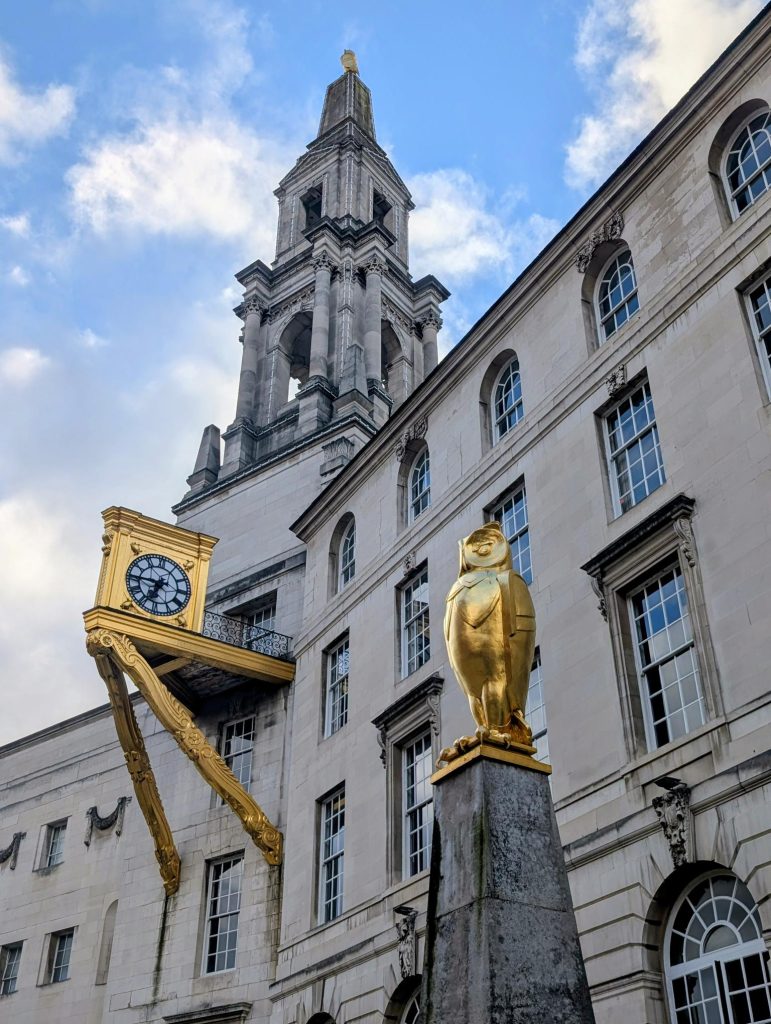
However, as our Professor Paul Willis would later explain, in strong teams, leadership gets distributed among members regardless of hierarchy, and this is certainly the case in Islington. We’d been running the “Making It Happen” campaign, celebrating the council’s various accomplishments. The residential happened to fall in the week preceding my section of the campaign. Leadership was therefore top-of-mind for multiple reasons as I arrived at Leeds Civic Hall, where Danni Clayton, Head of Comms for Leeds City Council and Treasurer of LGcomms, would host us very well over the following two days. I bumped into fellow Future Leader Laura beneath the Hall’s white stone towers, and our chatting eased my nerves. I was transfixed by the great golden owls that stood sentinel on the Hall’s perimeter, and their huge, unseeing eyes. Owls are a symbol of Leeds, and I recalled, of Athena, the ancient Greek goddess of wisdom. I hoped they’d guide me to not say anything especially stupid while on the programme.
Paul greeted us by name upon arrival. A warm, bright, and welcoming figure, he was like a human fireplace, giving off continuous sparks of humour and intelligence. His masterclass acquainted us with the fundamentals of leadership theory. When guiding us through the key themes – what makes great leadership; what our personal leadership style and values are; self-awareness and emotional intelligence; and influence/networks – he grounded them repeatedly in the day-to-day practicalities of local government communications.
Before all this he had us write down the type of leader we wanted to become. My answer featured the usual suspects of my half-formed thinking on leadership: “solution-focused”, “optimistic”, “creativity”, “honesty”, “vision” – and my personal go-to, “authenticity”. My relationship to this final term was usefully worried and refined by Paul’s teaching. “Every leadership style has a catch,” he said, be it visionary, coaching, pacesetting, democratic, commanding, or affiliative (people-oriented). The lattermost style prioritises positive, authentic relationships among a team; however, this can trade off on authority. Put simply, you can’t be a respected leader and everyone’s best friend. It’s been an ongoing challenge for me, balancing my natural friendliness with having others respect me, my skills, knowledge, and labour. My learning was greatly enhanced by my peers’ contributions – I recall Lauren describing a good leader as a reliable confidante who knows when to step forward and step back, and Hazel presenting leadership as a process, by which an individual unites others behind a common goal. Paul encouraged us to keep reflecting on our initial versions of our leadership styles, and this allowed me to develop the quality Paul put forward as the most important for any leader: self-awareness.
I take a hard-earned pride in my capacity for empathy and connection – qualities often lumped together in the workplace with that horrific phrase “soft skills”. As a gay, nonbinary person, I was relentlessly shamed for my feminine difference when growing up. I wasn’t tough in the way men “should” be tough, and therefore I was perceived as weak. However, I’ve realised my emotional intelligence makes me strong – my willingness to adapt my thinking, take other views into account, and admit (and therefore correct) my mistakes. Paul’s masterclass fortified my belief this could make me a great leader. However, his emphasis on the importance of possessing a variety of leadership styles also helped me see the overreliance on likeability I’ve sometimes fallen back on. It’s sharpened my focus for what I want from the programme: I want to add a dose of authority to my influence in the workplace. Our final exercise on the first day, mapping our networks and detailing the conversations we’d had with important stakeholders, gave me an idea of how to achieve this: having the right dialogues with the right people; building my communication knowledge and skills; modelling the qualities I appreciate most in colleagues, like reliability, collaboration, and gratitude; and knowing my worth.
I came away from Leeds with a clarified sense of how I want to develop as a leader, and a desire to visit again as a tourist. I managed to dip into the beautiful Leeds Art Gallery and appreciated some paintings by John Atkinson Grimshaw, a local Victorian painter I’d not heard of before. His nocturnal misty scenes of Leeds’ gothic streets and Big Ben submerged in Thames fog foreshadowed my journey back down to London. I also learned there’s an Owl Tour of Leeds, and goodness knows I’ll be taking that.